

SEO PowerSuite and Ahrefs cover many of the same SEO tasks, including keyword research, rank tracking, backlink analysis, competitor research and technical site audits. However, the way they deliver those capabilities is very different.
- SEO PowerSuite vs Ahrefs: Quick Comparison
- What Is SEO PowerSuite?
- What Is Ahrefs?
- The Biggest Difference: Desktop Software vs Cloud Platform
- SEO PowerSuite vs Ahrefs for Keyword Research
- Rank Tracking: Where the Pricing Models Become Important
- SEO PowerSuite vs Ahrefs for Backlink Analysis
- Technical SEO: WebSite Auditor vs Ahrefs Site Audit
- Competitor Research
- Link Building and Outreach
- AI Search Visibility
- Reporting and Agency Work
- SEO PowerSuite vs Ahrefs Pricing
- What Can You Use for Free?
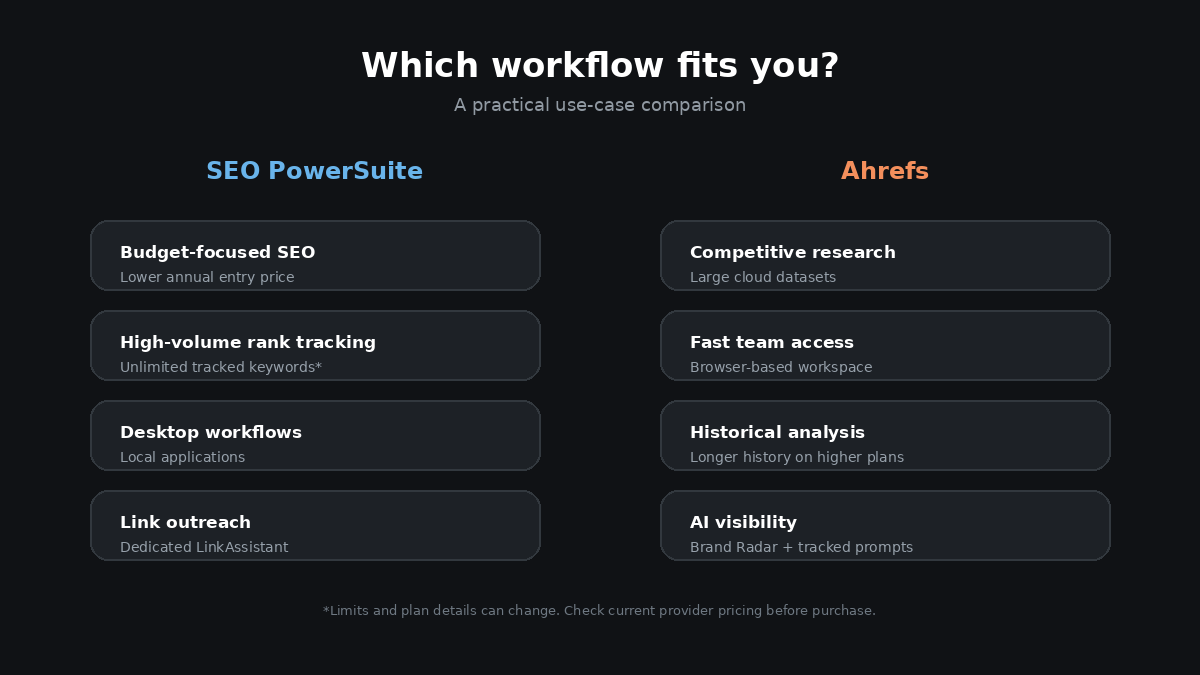
- SEO PowerSuite Is a Better Fit If You…
- Ahrefs Is a Better Fit If You…
- SEO PowerSuite vs Ahrefs for Small Businesses
- SEO PowerSuite vs Ahrefs for Agencies
- Can SEO PowerSuite Replace Ahrefs?
- SEO PowerSuite vs Ahrefs: Final Comparison
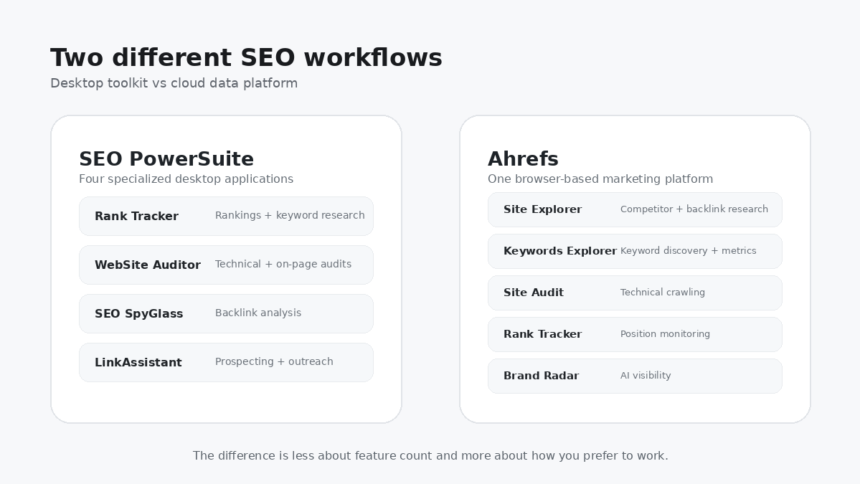
SEO PowerSuite is built around four downloadable desktop applications, while Ahrefs is a browser-based SEO and marketing platform powered by its own large search and backlink datasets.
That difference affects much more than the interface. It changes pricing, usage limits, collaboration, rank tracking, reporting and the type of SEO workflow each platform fits best.
This SEO PowerSuite vs Ahrefs comparison looks at those differences using current product information available in September 2026.
SEO PowerSuite vs Ahrefs: Quick Comparison
| Feature | SEO PowerSuite | Ahrefs |
|---|---|---|
| Platform | Desktop applications | Browser-based cloud platform |
| Keyword research | Rank Tracker with multiple research methods | Keywords Explorer with large keyword datasets |
| Rank tracking | Unlimited tracked keywords on paid suite plans | Plan-based keyword limits |
| Backlink research | SEO SpyGlass | Site Explorer |
| Technical SEO | WebSite Auditor | Site Audit |
| Link outreach | Dedicated LinkAssistant application | Research and link opportunity tools |
| AI search tracking | Google AI Overviews tracking | Brand Radar and tracked AI prompts |
| Projects | Unlimited projects on paid suite plans | Plan-dependent project limits |
| Entry paid plan | Professional: $349/year | Starter: $29/month; Lite: $129/month |
| Best fit | Budget-conscious SEOs who prefer desktop tools and high tracking limits | Teams and SEOs who prioritize cloud access, competitive data and fast research |
What Is SEO PowerSuite?
SEO PowerSuite is a collection of four SEO applications: Rank Tracker, WebSite Auditor, SEO SpyGlass and LinkAssistant.
Instead of placing every feature inside one browser dashboard, SEO PowerSuite separates different parts of SEO into dedicated applications.
- Rank Tracker covers keyword research, competitor analysis and search ranking monitoring.
- WebSite Auditor crawls websites for technical and on-page SEO issues.
- SEO SpyGlass analyses backlinks and referring domains.
- LinkAssistant focuses on link prospecting and outreach management.
The software is available for Windows, macOS and supported Linux systems. Projects primarily run through the desktop applications, although SEO PowerSuite also provides cloud storage for projects and reports on eligible plans.
This setup makes SEO PowerSuite different from most modern SaaS SEO platforms. You install the tools on your computer and use each application for a particular part of the SEO workflow.
What Is Ahrefs?
Ahrefs is a browser-based SEO and marketing platform. Its main tools include Site Explorer, Keywords Explorer, Site Audit, Rank Tracker, Content Explorer and Brand Radar.
Site Explorer combines several types of competitive intelligence in one interface. You can investigate organic keywords, pages, backlinks, paid search activity and competitor performance without installing desktop software.
Keywords Explorer is designed for keyword discovery and SERP research, while Site Audit handles technical crawling and Rank Tracker monitors selected keywords over time.
Ahrefs has also expanded beyond traditional SEO. Brand Radar measures brand visibility across AI search environments, adding AI mentions, citations and prompt monitoring to the platform’s existing search data.
The Biggest Difference: Desktop Software vs Cloud Platform
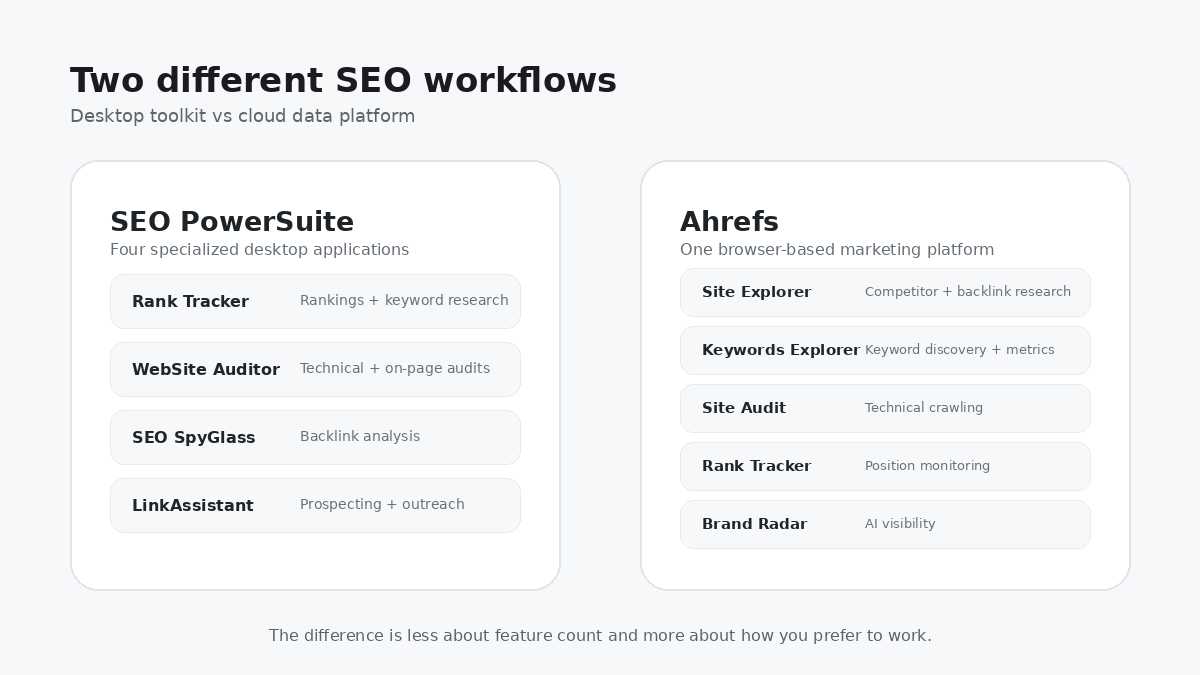
The most important difference between Ahrefs and SEO PowerSuite is not a particular backlink metric or keyword feature. It is how the software itself works.
SEO PowerSuite is desktop-first. You install its applications on your computer and run projects through those programs.
Ahrefs is cloud-first. You log in through a browser and access your projects and SEO data from the platform without running a local desktop crawler or rank tracking application.
Neither approach is automatically better.
A desktop workflow can be attractive when you want fewer plan-based limits on tasks such as rank tracking or project creation. SEO PowerSuite Professional, for example, currently allows unlimited projects and unlimited tracked keywords.
A cloud workflow is more convenient when several people need fast access from different devices or when competitive research is performed throughout the day without opening separate applications.
SEO PowerSuite vs Ahrefs for Keyword Research
Both platforms support serious keyword research, but they approach it differently.
SEO PowerSuite Keyword Research
Keyword research is mainly handled inside Rank Tracker.
SEO PowerSuite currently advertises more than 20 keyword research tools and methods. Rank Tracker can combine keyword discovery, ranking information and competitor analysis inside the same application.
This is useful if keyword research is closely connected to your rank tracking workflow. You can discover keywords, organise them and continue monitoring them without moving into another product.
Another important difference is tracking scale. Paid SEO PowerSuite plans currently advertise unlimited keyword tracking rather than a fixed number of tracked keywords.
Ahrefs Keyword Research
Ahrefs uses Keywords Explorer as its dedicated keyword research environment.
It provides keyword ideas alongside metrics such as search volume, Keyword Difficulty, traffic potential and SERP data. Keyword research can also connect directly with Site Explorer, allowing you to move from a keyword into the competitors and pages already receiving search traffic.
This makes Ahrefs particularly useful when keyword research is heavily based on competitor data.
Instead of beginning only with seed keywords, you can analyse a competing domain, identify the queries already generating visibility and then investigate those opportunities in Keywords Explorer.
Rank Tracking: Where the Pricing Models Become Important
Rank tracking exposes one of the biggest practical differences between the two platforms.
SEO PowerSuite Professional currently includes unlimited keyword tracking and supports rank monitoring across more than 550 search engines.
This can be attractive for users managing large keyword sets, many projects or more specialised search engines.
Ahrefs uses plan-based limits. Its current Lite plan includes 750 tracked keywords, Standard includes 2,000 and Advanced includes 5,000.
Ahrefs Rank Tracker focuses heavily on Google rankings across locations and devices and connects tracking data with other Ahrefs metrics and competitor information.
The difference is therefore not simply whether both tools can track rankings. They can.
The more important question is whether you prefer broad tracking capacity or a cloud-based rank tracking system connected directly to a larger competitive intelligence platform.
SEO PowerSuite vs Ahrefs for Backlink Analysis
Backlink analysis is another major overlap between the products.
SEO SpyGlass
SEO PowerSuite handles backlink analysis through SEO SpyGlass.
It can analyse backlinks and linking domains, identify new and lost links, separate dofollow and nofollow links and compare backlink profiles between websites.
The paid SEO PowerSuite packages currently advertise unlimited backlink tracking and analysis.
SEO SpyGlass also includes tools for evaluating link risk and preparing disavow files, which can be useful for more traditional backlink auditing workflows.
Ahrefs Site Explorer
Ahrefs handles backlink research primarily through Site Explorer.
Backlinks are only one part of the Site Explorer workflow. The same competitor profile can also show organic search performance, top pages, keywords, paid traffic and other competitive information.
This integration is one of Ahrefs’ main strengths. If you find a competitor with strong organic growth, you can move between its pages, rankings and backlink profile without leaving the same platform.
That makes Ahrefs particularly useful for competitive research where backlinks need to be understood together with organic performance rather than analysed in isolation.
Technical SEO: WebSite Auditor vs Ahrefs Site Audit
Both tools can crawl websites and identify technical SEO issues.
SEO PowerSuite uses WebSite Auditor, which covers technical audits, page-level optimisation, internal linking, site structure, Core Web Vitals checks and content analysis.
Professional plans allow users to crawl and audit complete websites rather than remaining limited to the 500 URLs available in the free edition.
Ahrefs Site Audit runs in the cloud. The current Lite plan includes 100,000 crawl credits per month and supports up to 25,000 pages per project. Higher plans increase those limits substantially.
Ahrefs currently checks websites against more than 170 predefined technical and on-page SEO issues.
The practical difference again comes down to workflow. WebSite Auditor performs the work through a local application, while Ahrefs Site Audit keeps crawl projects and reports inside the cloud platform.
Competitor Research
Ahrefs has a strong advantage in how tightly competitor data is connected across its platform.
Site Explorer can show which pages generate estimated organic traffic, which keywords a competitor ranks for, how its backlink profile changes and where its visibility is growing.
From there, the research can continue into Keywords Explorer, Content Explorer or other Ahrefs reports.
SEO PowerSuite also supports competitor analysis across Rank Tracker, SEO SpyGlass and WebSite Auditor, but the workflow is distributed across separate desktop applications.
This can provide plenty of information, but it requires a different working style.
If competitor research is something you perform continuously throughout the day, Ahrefs’ single browser environment may feel more efficient. If your process is built around scheduled projects and dedicated SEO tasks, the separate SEO PowerSuite applications may be less of a disadvantage.
Link Building and Outreach
SEO PowerSuite includes one component that makes the comparison particularly interesting: LinkAssistant.
LinkAssistant is designed specifically for link prospecting and outreach management. It can help find potential link opportunities and organise outreach campaigns within the SEO PowerSuite ecosystem.
Ahrefs provides extensive data for finding link opportunities through competitor backlinks, broken links, referring domains and content research.
However, Ahrefs’ main strength in this area is research and link intelligence rather than acting as a dedicated outreach-management application.
For teams that already use another outreach platform, this difference may not matter. For users wanting prospect research and campaign management inside the same SEO toolkit, LinkAssistant gives SEO PowerSuite an additional workflow that Ahrefs does not mirror in exactly the same way.
AI Search Visibility
Both platforms are adapting to AI-generated search, but their current approaches are different.
SEO PowerSuite added Google AI Overviews tracking to Rank Tracker in 2026. This lets users monitor whether AI Overviews appear for tracked queries and analyse visibility in that part of Google’s search results.
Ahrefs has taken a broader approach with Brand Radar. Its AI visibility features cover brand mentions, citations and monitored prompts across multiple AI environments in addition to Google search.
This distinction matters because tracking an AI Overview for a keyword and measuring brand visibility across AI assistants are related but different tasks.
If AI visibility is becoming part of your SEO reporting, see Algonixy’s guide on
how to track brand mentions in AI search.
It explains the difference between mentions, citations, recommendations, share of voice and referral traffic.
Reporting and Agency Work
SEO PowerSuite changes significantly between its Professional and Enterprise editions.
Professional is positioned primarily for smaller businesses and in-house use. Enterprise adds agency-oriented capabilities including white-label SEO reports, customisable report templates, scheduled report delivery and data exports.
Ahrefs also supports reporting, exports, project management and API access, but limits vary by subscription level.
Its current plans are structured more traditionally around increasing access to data, projects, tracked keywords, crawl capacity, historical information and reporting features.
For an agency, this creates two different cost models.
SEO PowerSuite can provide high project and keyword capacity for a comparatively low annual software price, while Ahrefs charges considerably more but provides a cloud environment and immediate access to its competitive search datasets.
SEO PowerSuite vs Ahrefs Pricing
Pricing is one of the largest differences between SEO PowerSuite and Ahrefs.
| SEO PowerSuite | Current Price |
|---|---|
| Free | $0 |
| Professional | $349/year |
| Enterprise | $599/year |
| Max | $899/year |
SEO PowerSuite Professional works out to roughly $29 per month when the annual price is divided across twelve months, although it is billed annually rather than as a $29 monthly subscription.
| Ahrefs | Current Price |
|---|---|
| Free account | $0 |
| Starter | $29/month |
| Lite | $129/month |
| Standard | $249/month |
| Advanced | $449/month |
Ahrefs Enterprise currently starts at $1,499 per month with an annual commitment.
The Starter plan should not be treated as a direct equivalent of SEO PowerSuite Professional. It is a lower-limit entry product, while Ahrefs Lite is the first main subscription tier aimed at small businesses and personal projects that need broader access to the platform.
Pricing therefore needs to be compared together with limits rather than by monthly cost alone.
SEO software pricing and plan limits change regularly. Check the current provider pricing before purchasing a subscription.
What Can You Use for Free?
Both companies provide free access, but the free products work differently.
SEO PowerSuite’s free edition currently allows one project, crawling and auditing of up to 500 URLs, analysis of up to 1,100 backlinks and monitoring of one competitor per project. Some saving and reporting capabilities are restricted.
Ahrefs offers a free account for verified websites with limited access to tools such as Site Explorer and Site Audit, alongside several standalone free SEO tools.
The free versions are useful for evaluating the platforms, but they should not be confused with the full paid workflows compared throughout this article.
SEO PowerSuite Is a Better Fit If You…
- want to track large keyword sets without the same plan-based keyword caps;
- manage many SEO projects;
- prefer downloadable desktop software;
- want dedicated tools for ranking, auditing, backlinks and outreach;
- need a lower-cost professional SEO toolkit;
- work with search engines beyond the most common Google-focused workflows;
- want dedicated link outreach functionality through LinkAssistant.
Ahrefs Is a Better Fit If You…
- want a browser-based SEO platform accessible from different devices;
- perform competitor research frequently;
- depend heavily on backlink and organic search datasets;
- want keyword, competitor, backlink and site data tightly connected;
- need stronger cloud-based collaboration;
- want integrated AI visibility monitoring through Brand Radar;
- value fast research workflows more than very high rank-tracking limits.
SEO PowerSuite vs Ahrefs for Small Businesses
Small businesses should pay particular attention to how much of each platform they will actually use.
A company that mainly needs technical audits, keyword tracking and occasional competitor research may not need the scale of data available in a more expensive Ahrefs subscription.
SEO PowerSuite Professional can cover a wide range of traditional SEO tasks at a lower annual price, especially when large keyword tracking limits matter.
On the other hand, a business that constantly researches competitors, backlinks, keywords and new content opportunities may benefit more from having Ahrefs available instantly in the browser.
The cheaper tool is not automatically the more economical option. A platform that saves significant research time can justify a higher subscription price, while paying for data and features that are rarely used creates unnecessary cost.
SEO PowerSuite vs Ahrefs for Agencies
Agencies face a different decision because project count, reporting, collaboration and client research become more important.
SEO PowerSuite Enterprise is designed specifically for professional SEO and agency work. It adds white-label reporting, report scheduling, exports and higher competitor limits while keeping unlimited projects and keyword tracking.
Ahrefs can be significantly more expensive as usage grows, but its cloud interface can make research easier to share across a team.
Agencies that spend a large part of their day analysing new domains may prefer the speed of a central browser platform. Agencies with large rank-tracking portfolios and established reporting processes may find SEO PowerSuite’s limit structure attractive.
Team size also matters. Ahrefs charges for additional users depending on the selected plan, while SEO PowerSuite licensing and its desktop-first workflow need to be evaluated differently when several team members need simultaneous access.
Can SEO PowerSuite Replace Ahrefs?
SEO PowerSuite can replace many of the core SEO functions people use Ahrefs for, including rank tracking, keyword research, technical audits, backlink analysis and competitor monitoring.
That does not mean the two products provide identical data or workflows.
Ahrefs’ advantage is the integration of large competitive datasets into a fast cloud interface. SEO PowerSuite’s advantage is the amount of traditional SEO functionality and tracking capacity available at a much lower annual software cost.
Whether one can replace the other therefore depends on the work you actually perform.
If most of your workflow consists of audits, ranking reports, keyword monitoring and backlink analysis for known projects, SEO PowerSuite can cover a large part of that workload.
If you constantly move between unfamiliar competitors, keywords, pages and backlink profiles to discover new opportunities, Ahrefs provides a different type of research experience that is difficult to compare using feature checklists alone.
SEO PowerSuite vs Ahrefs: Final Comparison
SEO PowerSuite and Ahrefs solve many of the same SEO problems, but they are built around fundamentally different product models.
SEO PowerSuite focuses on dedicated desktop applications, high tracking capacity and comparatively affordable annual plans. It is particularly interesting for users who manage many projects or keywords and do not mind working through installed software.
Ahrefs focuses on cloud-based competitive intelligence. Its main tools connect keyword research, rankings, backlinks, site audits, competitor performance and newer AI visibility data inside one browser platform.
The choice is therefore less about asking which platform has “more SEO features”. Both cover the core SEO workflow.
The more useful question is whether your work depends more on tracking and managing known SEO projects or on quickly researching markets, competitors and opportunities through large connected datasets.
That distinction is likely to matter more in daily use than any single feature on a comparison table.