

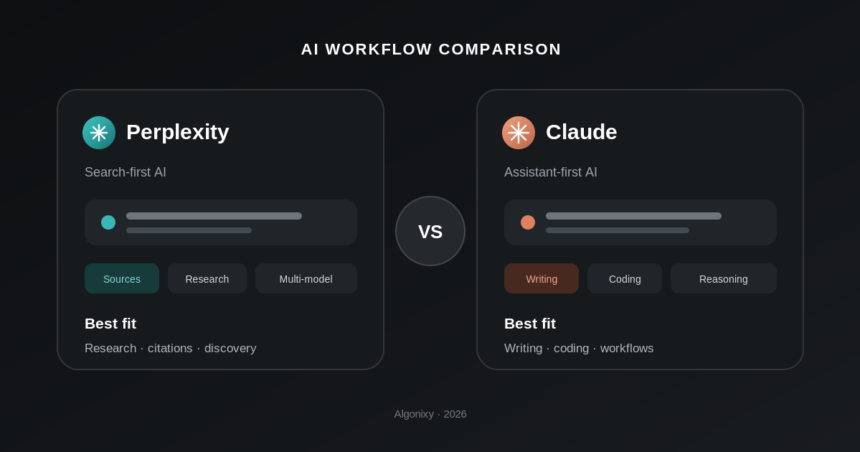
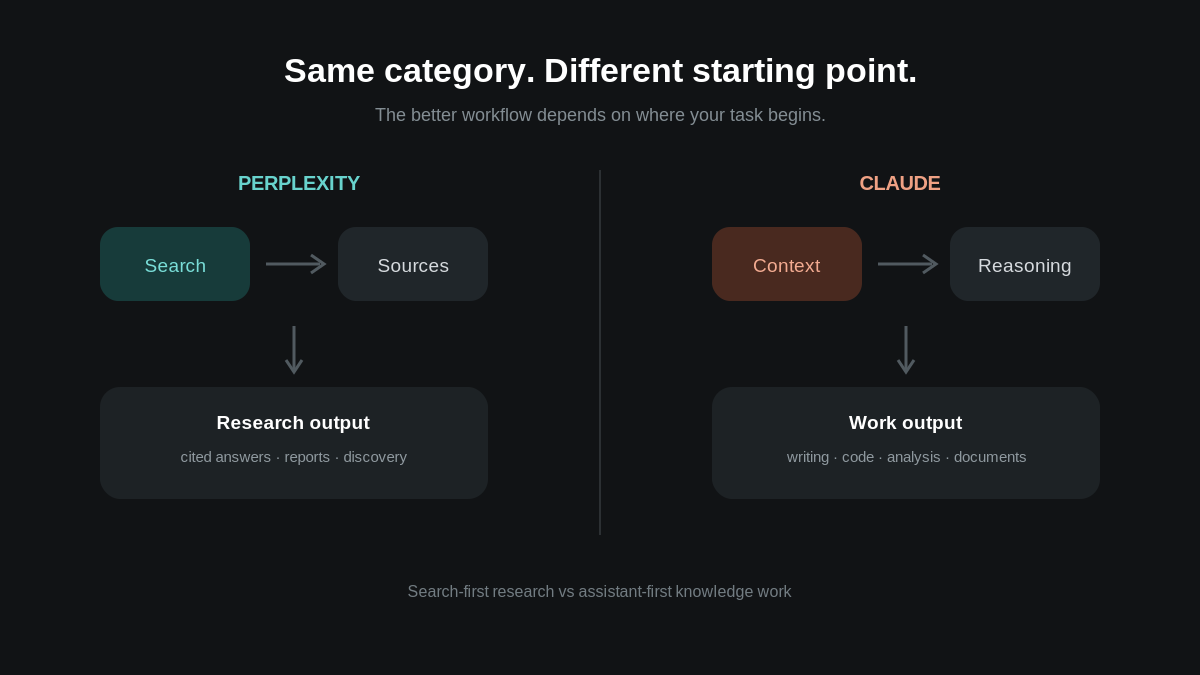
Perplexity and Claude can both search the web, analyse information, work with files and answer complex questions, but they are built around different workflows. Perplexity starts with search, sources and research. Claude is a broader AI assistant built around reasoning, writing, coding and working through longer tasks.
- Perplexity vs Claude: Quick Comparison
- Perplexity vs Claude at a Glance
- What Is Perplexity?
- What Is Claude?
- Perplexity vs Claude for Search and Research
- Citations and Source Transparency
- Perplexity vs Claude for Writing
- Perplexity vs Claude for Coding
- Files, Projects and Longer Workflows
- Model Choice: A Major Difference
- Perplexity vs Claude Pricing
- Perplexity vs Claude for Research
- Which AI Is Easier to Use?
- Accuracy: Can You Trust Perplexity or Claude?
- Perplexity or Claude: Which Should You Choose?
- Perplexity vs Claude: Final Comparison
That distinction matters more than simply asking which model is “smarter”. The better choice depends on whether you mainly want to find and verify information or whether you need an AI workspace for creating, analysing and building with that information.
Perplexity vs Claude: Quick Comparison
Perplexity is the stronger fit for search-first research. Its product is built around finding current information, surfacing sources and making citations easy to inspect.
Claude is the stronger fit when research is only the beginning. It is better suited to long-form writing, detailed reasoning, document work, coding and workflows where you need to continue working with information after finding it.
There is also an important difference between the two platforms. Perplexity is a multi-model platform and can provide access to AI models from different providers. Claude, on the other hand, is Anthropic’s own AI assistant and is built around the Claude model family.
Perplexity vs Claude at a Glance
| Feature | Perplexity | Claude |
|---|---|---|
| Core experience | AI search and research platform | General AI assistant and work environment |
| Web research | Excellent | Very good |
| Citations | Central to the normal search experience | Available with web search and research |
| Long-form writing | Good | Excellent |
| Coding | Good for research and technical questions | Strong dedicated coding workflows |
| Model choice | Models from multiple AI providers | Claude model family |
| File analysis | Yes | Yes |
| Deep research | Research-first workflow | Research inside a broader assistant |
| Best for | Research, citations and source discovery | Writing, reasoning, coding and knowledge work |
What Is Perplexity?
Perplexity is best understood as an AI answer engine rather than a conventional chatbot. Its normal workflow begins with information retrieval: you ask a question, Perplexity searches relevant sources, combines what it finds and presents citations alongside the answer.
This makes Perplexity particularly useful when the source of an answer matters. Instead of receiving a response first and then having to ask where the information came from, sources are already integrated into the research experience.
Perplexity has also expanded beyond simple search. The platform includes deeper research features, file analysis, project-based workflows and access to advanced AI models from multiple providers depending on the selected plan.
This multi-model approach is one of the most important differences in the Perplexity vs Claude comparison. A Perplexity subscription is not necessarily tied to a single AI model family.
What Is Claude?
Claude is Anthropic’s AI assistant. While it can search the web and perform research, its product is designed around a broader type of work: analysing information, reasoning through complex problems, writing, working with documents and generating code.
Claude is therefore less search-engine-like than Perplexity. You can begin with research, but you can also start with a document, a codebase, a draft or a complex problem that does not require web search at all.
This makes Claude particularly interesting for users who want an AI assistant to remain involved after the information-gathering stage.
Perplexity vs Claude for Search and Research
Search is where the difference between Perplexity and Claude becomes easiest to notice.
Perplexity is web-first. Searching current information is not simply an additional feature. It is one of the main reasons the platform exists.
Its answers are designed around retrieving information from the web and displaying the sources behind the response. This makes the workflow particularly efficient when you need to research a topic, compare information across websites or quickly verify where a claim came from.
Claude can also search the web and perform more detailed research, but research sits inside a broader AI workspace. That becomes useful when your research needs to continue into another task, such as creating a report, rewriting a document, analysing an uploaded file or developing a strategy.
For users whose main task is finding and verifying information, Perplexity offers the more specialised workflow. If research is only the first stage of a larger project, Claude becomes more interesting.
Citations and Source Transparency
Perplexity’s citation system is one of its clearest strengths. Answers are built around direct references, making it easy to open a source and inspect the original page behind a statement.
This can be especially useful for marketers, SEO professionals, researchers, journalists and anyone working with information that needs to be checked before publication.
Claude can also provide citations when using web search and research features. However, neither tool should be treated as automatically correct simply because sources are displayed.
A citation shows where information came from, but it does not guarantee that an AI system interpreted the source correctly. Important information should still be checked against the original source.
Perplexity vs Claude for Writing
Claude’s advantages become clearer when you move from finding information to producing something with it.
For long-form writing, restructuring documents, developing arguments, editing drafts and maintaining context across a larger piece of work, Claude feels more like a collaborative writing and reasoning assistant.
Perplexity can also generate articles, summaries and other written content. However, its core workflow remains more research-led: find information, understand the sources and generate an answer from them.
Claude is particularly useful when the task starts with something you already have, such as:
- a rough article draft that needs restructuring;
- a long PDF that needs analysis;
- a strategy document that needs expansion;
- multiple pieces of context that need to be combined;
- a detailed piece of content that will go through several revisions.
For content workflows, Perplexity can be particularly useful during the research stage, while Claude is often better suited to developing and refining the finished work.
Perplexity vs Claude for Coding
Both platforms can help with technical tasks, but Claude has a stronger identity as a coding assistant.
Claude can help users understand existing code, plan changes, debug problems, generate new code and work through larger technical tasks.
Perplexity is also useful for coding, especially when the problem requires current information from the web. It can help research documentation, compare frameworks, investigate software errors or find information about APIs and libraries.
Perplexity is useful for coding when you need to:
- research APIs or documentation;
- find current technical information;
- compare software frameworks;
- investigate errors using web sources;
- find examples from different sources.
Claude is useful for coding when you need to:
- work with a larger codebase;
- analyse several files together;
- generate or restructure code;
- reason through more complex programming problems;
- continue working on a development task over multiple steps.
Files, Projects and Longer Workflows
Modern AI assistants increasingly need to understand more than a single prompt. Both Perplexity and Claude support working with uploaded files and longer project contexts.
Perplexity can combine uploaded material with external web research. This is useful when your own documents are only part of the information you need.
Claude is particularly useful when the uploaded material itself becomes the centre of the project. A report, group of documents or codebase can become working context for continued analysis and editing.
The distinction is therefore similar to the wider comparison: Perplexity is especially useful when external discovery matters, while Claude is strong when you need to continue working deeply with existing information.
Model Choice: A Major Difference
One of the most important differences between Claude and Perplexity is how they approach AI models.
Claude is Anthropic’s own product. When you use Claude directly, you are working inside Anthropic’s platform and with Anthropic’s Claude model family.
Perplexity takes a different approach. Depending on the selected plan and current availability, users can access advanced models from multiple AI providers.
This means that using Perplexity does not necessarily mean avoiding Claude models entirely. In some cases, users may be able to select a Claude model while still using Perplexity’s search and citation interface.
However, using a Claude model through Perplexity is not the same experience as using Claude directly. Each platform provides its own interface, tools, context management and workflow.
Perplexity vs Claude Pricing
Both Perplexity and Claude offer free versions as well as paid plans. Their standard paid subscriptions are positioned at a similar price level, although included features and usage limits differ.
| Plan | Price | Main Focus |
|---|---|---|
| Perplexity Free | Free | Basic AI search and research |
| Perplexity Pro | About $20/month | Advanced research, models and higher limits |
| Claude Free | Free | General AI assistant with limited usage |
| Claude Pro | About $20/month | Higher usage and additional Claude features |
Because the standard paid plans are priced similarly, price alone is unlikely to be the deciding factor for many users.
The more important question is which workflow you are actually paying for.
AI pricing, model availability and usage limits can change frequently. Check the provider’s current pricing page before subscribing.
Perplexity vs Claude for Research
If your main use case is research, Perplexity has one of the clearest advantages in the comparison.
It makes research feel like an enhanced search workflow: ask a question, review the answer, inspect the cited sources, refine the search and continue investigating.
Claude becomes more attractive when research means more than finding information.
For example, imagine that you need to:
- research a market;
- analyse your internal documents;
- identify important findings;
- turn the findings into a strategy;
- write a complete report;
- continue editing the report afterwards.
In that type of workflow, Claude’s broader approach becomes more valuable.
Which AI Is Easier to Use?
Both platforms are easy to start using, but they encourage different behaviours.
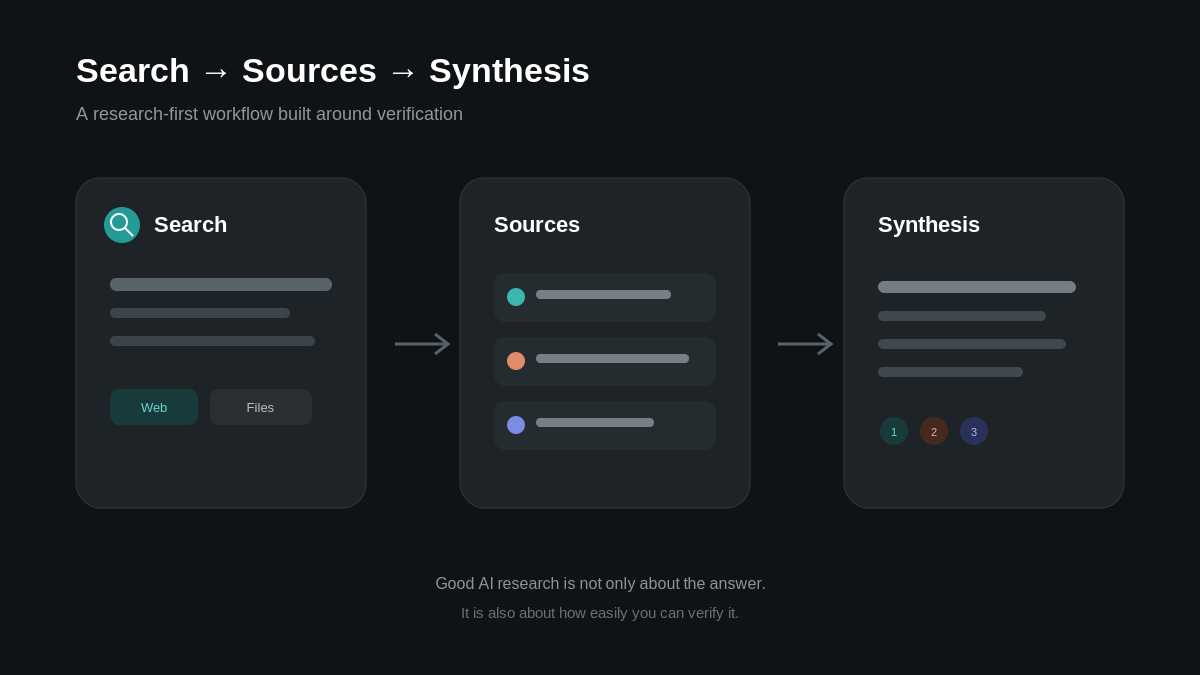
Perplexity is very direct when you already know what you want to investigate. Its normal workflow is essentially:
Search → answer → sources → follow-up question.
Claude feels more open-ended. You can ask a normal question, upload a document, work on a writing task, analyse information or begin a coding project without needing to frame everything as research.
Users coming from a traditional search engine may find Perplexity immediately familiar, while users looking for a broader AI collaborator may prefer Claude.
Accuracy: Can You Trust Perplexity or Claude?
Neither Perplexity nor Claude should automatically be assumed to be correct simply because an answer sounds confident.
Both AI systems can misunderstand information, omit important context or generate incorrect details.
The advantage of a citation-heavy research workflow is not that mistakes disappear. Instead, citations make it easier to inspect the evidence behind an answer.
When using either platform for important research, you should:
- open the original source;
- prefer primary sources when they are available;
- check publication and update dates;
- verify important numbers and claims;
- compare several sources when information is disputed.
This is especially important for fast-changing topics such as AI models, software features and pricing.
Perplexity or Claude: Which Should You Choose?
Choose Perplexity if:
- web research is your main use case;
- you want citations directly inside normal answers;
- you frequently research current topics;
- you need to compare information across many sources;
- you prefer a search-first workflow;
- access to different AI model providers is important to you.
Choose Claude if:
- you write or edit long-form content;
- you work with complex documents;
- you want deeper reasoning across longer tasks;
- coding is an important part of your workflow;
- you want to continue working with the same context;
- you want research inside a broader AI workspace.
Perplexity vs Claude: Final Comparison
Perplexity and Claude overlap in many areas, but they still approach AI from different directions.
Perplexity is particularly strong for focused web research, source discovery and citation-first answers. Its interface is designed around finding information and making the evidence behind that information easy to inspect.
Claude is particularly strong for writing, reasoning, coding and longer knowledge-work tasks. Research is available when needed, but it forms only one part of a broader AI assistant.
The decision between Claude and Perplexity therefore depends less on which platform has the longest feature list and more on where your workflow starts.
If your work usually starts with “I need to find reliable information about this”, Perplexity is likely to feel more natural.
If your work usually starts with “I need to create, analyse or build something from this information”, Claude may fit the workflow better.